Skryne in a Nutshell: 10 Key Facts
The Hill of Skryne, a short distance from Tara, is crowned by a medieval church ruin and tower that mark an early Christian and Norman landscape. Its Irish name recalls the shrine of Colmcille, once brought here for safekeeping.
 Ruins of a Medieval church on the Hill of Skryne
- A hilltop landmark close to Tara. The Hill of Skryne (Skreen) lies only a few kilometres east of the Hill of Tara and is crowned by a prominent medieval church ruin.
- The name preserves a major Columban connection. Skryne derives from the Irish Scrín Choluim Chille, meaning “Colmcille’s shrine”, a reference to the safeguarding of a shrine or relics associated with St Colmcille.
- Earlier tradition remembers the place as Achall. Medieval sources preserve the older name “Achall” for the hill, showing the site had a recognised identity before the “shrine of Colmcille” name became established.
- Relics were brought here for protection in 875. In AD 875, the shrine and relics of St Colmcille were brought to the monastery at Skryne for safekeeping, reflecting the pressures of the Viking Age and the need to protect prized reliquaries.
- The monastery was repeatedly attacked. Sources record that the monastic site was plundered several times in the later 10th to 12th centuries, and the shrine was robbed in 1027 before being recovered.
- The main ruins are a medieval church with a later tower. The church is generally dated to the 14th century, with the substantial west tower added in the 15th century, creating the silhouette that defines the hill today.
- A classic two-part plan. The building follows a common medieval layout with a nave and chancel, and the tower contains surviving fragments such as a baptismal font and a tomb slab.
- A late medieval stone cross stands nearby. To the north-east of the church is a late medieval stone cross, noted for a Crucifixion carving on its west face.
- Norman lordship reshaped Skryne in the 12th century. Around the time of the Norman settlement in Meath, Hugh de Lacy granted Skryne to his knight Adam de Feypo (de Feipo), establishing a powerful local lordship.
- A castle and barony grew from that grant. Adam de Feypo is associated with a motte-and-bailey castle at Skryne, and the de Feypo family used the title “Baron Skryne” in later medieval records.
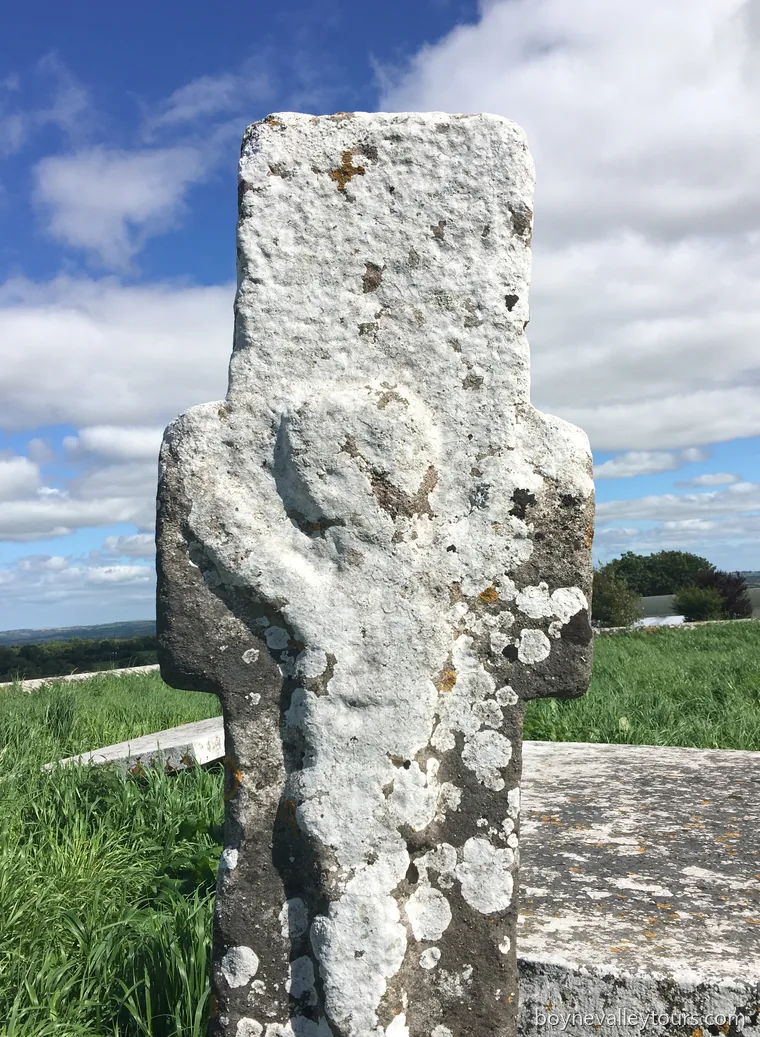 Late medieval stone cross | Hill of Skryne
The Hill of Skryne
The Hill of Skryne is a distinctive historic landmark in County Meath, rising to the east of the Hill of Tara and forming part of the wider Boyne Valley cultural landscape. Although quieter and less visited than Tara, Skryne has deep associations with early Christianity, medieval lordship, and local tradition that span more than a thousand years.
A strategic hill in the Tara hinterland
Skryne occupies a prominent hilltop position overlooking fertile lowlands and historic routeways. Its visibility from neighbouring hills, including the Hill of Slane, suggests that the site held both symbolic and practical importance within the royal and ecclesiastical landscape of early medieval Meath.
The meaning behind the name Skryne
The name Skryne, also spelled Skreen, derives from the Irish Scrín Choluim Chille, meaning “the shrine of Colmcille”. This reflects the site’s close association with Saint Colmcille and highlights its role as a place of safekeeping for important religious objects during unsettled times.
Relics protected during the Viking Age
In AD 875, the shrine and relics of Colmcille were brought to a monastery at Skryne for protection. This move reflects the instability of the Viking Age, when monastic centres across Ireland were threatened by raids and communities sought safer locations.
An early monastic site with a long memory
Although little survives above ground from the earliest monastery, historical references confirm Skryne’s role as a religious centre well before the Norman period. The continued importance of the hill suggests a strong tradition of ecclesiastical use from the early Christian era onward.
The medieval church and tower
The ruins visible today consist mainly of a late medieval church with a substantial west tower, dating largely from the 15th century. The tower dominates the skyline and gives Skryne its instantly recognisable profile when viewed from the surrounding countryside.
A late medieval stone cross
To the north-east of the church stands a late medieval stone cross. Carved on its west face is a Crucifixion scene, providing evidence of devotional sculpture and religious expression at Skryne during the later Middle Ages.
Norman power and the Barony of Skryne
Following the Norman arrival in Meath, Hugh de Lacy granted the Barony of Skryne to his leading knight, Adam de Feipo. This grant established Skryne as an important manorial centre, reshaping the political landscape of the area.
Castle, barony, and medieval settlement
Adam de Feipo is associated with a motte and bailey castle at Skryne, and his family later held the title Baron of Skryne. The presence of both ecclesiastical and secular power on the hill reflects its enduring strategic value.
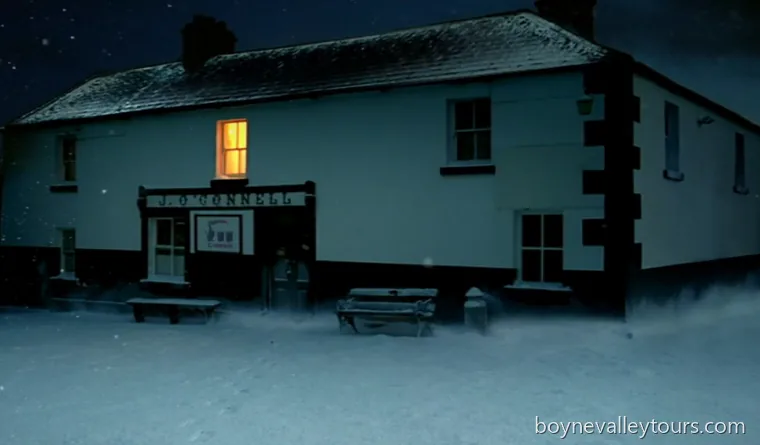 O'Connell's Pub, Hill of Skryne
Skryne in local life and tradition
Beside the medieval ruins, O’Connell’s Pub has long been a focal point for the local community and the social heart of Skryne. The pub gained wider recognition when it featured in a well-known Guinness television advertisement.
Today, the Hill of Skryne remains a quietly powerful heritage site, valued for its early Christian associations, medieval remains, Norman history, and its continuing role in the cultural life of County Meath.